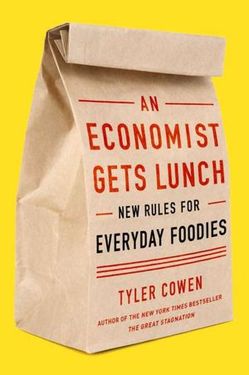
The Boston Globe on Cowen on food

Cowen’s book offers more than ethnic-dining tips, however; it situates them in a broad historical context. Many of today’s mainstream foodies, Cowen argues, have the history of American food all backwards. They assume that American food is so terrible and unhealthy because of agribusiness: We eat terribly, the thinking goes, because our food is frozen, packaged, and trucked over vast distances before we eat it. Cowen has an entirely different explanation for the mediocrity of American food. As he sees it, American food was ruined by a series of entirely contingent historical events — Prohibition, the Great Depression, the Second World War, and the rise of TV — which effectively ruined the restaurant industry. Those events were especially damaging, he argues, because immigration was so severely restricted during much of the 20th century. Immigrants were the people who can do the most interesting things with the cheap food on offer in the United States; without them, American food became boring and bland.

An Economist Gets Lunch: New Rules for Everyday Foodies

Now that immigration is on the rise again, America is a food paradise: the extended food supply chain created by American agribusiness means that food is plentiful and cheap, while our vibrant immigrant communities take that cheap food and make it awesome in a million different ways. (Barbecue is an example of a home-grown food culture which acts, in many respects, like an immigrant one.) The essence of American food, Cowen argues, is that it’s inexpensive, innovative, and various. To eat well in America, you have to embrace its unique history, and start from the fact that “the United States is a country where the human beings are extremely creative but the tomatoes are not extraordinarily fresh.” If you’re obsessed with the farmer’s market, you’ve got American food wrong; instead, think of America as a hotbed of “food innovation,” where the best food is getting made at strip malls and in food trucks. It’s an alternate vision of food in America.

That is Josh Rothman, there is more here. Here is a Q&A with me on food, and what is always in my cupboard: “Goya beans, cumin seed, dried ancho chilies.”

Originally posted on Marginal Revolution – click to see comments and suggestions.

Also see: The Korean on “An Economist Gets Lunch”, from Ask a Korean!

Related Posts:

Posted in An Economist Gets Lunch, Books, Korean | Tagged , , , , , | Comments Off on The Boston Globe on Cowen on food

The Matt Yglesias take on restaurant decline

Matt writes:

Imagine some diners are, by temperament, venturesome while others are regulars. Over the long term, the best business strategy is to appeal to regulars since they offer a stable client base. But when a restaurant is new, it by definition lacks regulars and needs to appeal to venturesome diners both to get an initial wave of customers and also to attract “buzz” and get the temperamental regulars in the door. Over time, a successful restaurant will attempt to switch and become more a place for regulars, which means that venturesome diners will come to like it less. At the same time, alienating venturesome foodies is very low cost because being venturesome they would perceive their own growing familiarity with the food as declining quality one way or the other.

Beautiful woman, by suneko

Beautiful woman, by suneko

This is not at all far from my basic theory, though Matt seems to imply it is. In An Economist Gets Lunch I stress how the cycle of “ceasing to appeal to the informed diners” has very much accelerated with the internet. Good reviews arrive rapidly, perhaps too rapidly. If there is a new place you quite like — especially if it is trendy — go many times now, because it will decline in quality more rapidly than such places used to. Once the place is established, it can get by more on momentum and on its value as a focal venue for socializing. You can take the presence of a lot of beautiful women as one sign that a place has crossed into this territory.

Don’t think of the model as “what happens to a restaurant when there is an exogenous increase in the beauty of its women” (recall Scott Sumner — “don’t reason from a beautiful women [price] change!”). Think of the model as “what does lots of beautiful women predict about the place of a restaurant in its product life cycle?”

Restaurants with beautiful women are still better than average, relative to the population of restaurants as a whole, for obvious reasons related to wealth and demographics. They’re just not likely to be the very best of the good restaurants, especially for the price.

Arguably it is a different case when a restaurant has beautiful women, but most mainstream male patrons would regard those women as “ineligible,” or “unapproachable,” perhaps for reason of a different religion or ethnicity. At those restaurants you can enjoy both great food for the price and beautiful women, though perhaps your enjoyment of the latter will remain at some distance.

Originally posted on Marginal Revolution – click to see comments and suggestions.

Related Posts:
Posted in An Economist Gets Lunch, Beautiful Women | Comments Off on The Matt Yglesias take on restaurant decline

Rice Paper

Rice Paper, web site, 6775 Wilson Blvd., Eden Center, Falls Church, VA, 703-538-3888, Eden Center, (Metro Trip Planner – opens in new window) [Washingtonian | Vim’s Palate | Don Rockwell | Yelp]

Rice Paper Kite, by muffinman71xx

Rice Paper Kite, by muffinman71xx

The trendiest Vietnamese place around, and the one hardest to get in to, and the one with the most beautiful women. The food here is above average, but it’s for me not worth the hassle. The dishes are made too sweet to appeal to the crowd, even though the ingredients are above average and the décor looks nice. Many of you will have this place as your favorite, but for me it is a dominated asset. Astute diners will note the presence of snails in coconut cream, otherwise they don’t seem to have special dishes. If you can get a table, however, there is no particular reason not to go.

Related Posts:

Posted in Beautiful Women, Eden Center, Falls Church/Seven Corners, Vietnamese, Virginia | Tagged , , | 2 Comments

“Avoid beautiful women and popular locations”

Picking a restaurant may be an art form, but one economist is trying to apply theoretical economic principles to make the process of selecting your next meal out worthwhile.

Professor Tyler Cowen suggests that diners avoid hyped-up eateries or places that focus too much attention on the atmosphere rather than the food.

An Economist Gets Lunch: New Rules for Everyday Foodies

The most adventurous eats come from places with the lowest overhead, and considering food trucks have the fewest staff and no permanent address, they certainly have the most incentive to try out new dishes without taking a capital hit.

If you are going to stick it out with the fancy, well-established restaurants instead, one move to make sure that you are getting a plate of their best talent is to order the lesser-known dishes.

Avoid beautiful women and popular locations: How to get the most out of your restaurant selections by taking counter-intuitive tips,” by Meghan Keneally, Mail Online, April 12, 2012

Related Posts:

Posted in An Economist Gets Lunch, Beautiful Women, Books | Tagged , | Comments Off on “Avoid beautiful women and popular locations”

Huffington Post covers “An Economist Gets Lunch”

The interview is here, with Arin Greenwood, here is one excerpt:

For the world as a whole the main thing we need to do is invest more in increasing agricultural productivity. It’s really slowed down since the 1990s. It’s a major problem for at least one billion people. I think it’s much more important than what people like Michael Pollan usually talk about. For the U.S., I think we should have a carbon tax, for environmental reasons.

I think as individuals, people overrate the virtues of local food. Most of the energy consumption in our food system is not caused by transportation. Sometimes local food is more energy efficient. But often it’s not. The strongest case for locavorism is to eat less that’s flown on planes, and not to worry about boats.

An Economist Gets Lunch: New Rules for Everyday Foodies

And this:

This will sound a little strange coming from me. The two dynamic sectors now are hamburgers and pizza.

And this:

There are any number of places with good decor and great food, they just cost a very high price. Most people don’t want to eat at those places on a regular basis for reasons of money or time, or just the sheer oppression of having to dress up and go to a nice place all the time.

Q&A With Tyler Cowen, The George Mason University Economist Who Likes To Eat,” by Arin Greenwood, The Huffington Post, April 12, 2012

Related Posts:

Posted in An Economist Gets Lunch, Books, Hamburgers, Pizza | Tagged , , , , | Comments Off on Huffington Post covers “An Economist Gets Lunch”

Six Rules for Dining Out

Please see

http://tylercowensethnicdiningguide.com/?page_id=2393

Related Posts:

Posted in An Economist Gets Lunch, Beautiful Women, Eden Center, Falls Church/Seven Corners, General remarks, General Tips, Indian, New York, Pakistani, Thai, Vietnamese, Virginia | Tagged | 2 Comments

“Thucydides Gets Lunch”

To find good food and not get fleeced, he recommends, leave the city centers and seek marginal areas. Mr. Trillin has been saying this for at least 40 years. I suspect Thucydides preferred the little joint on a side street to the place with the fountains where the waiters peeled customers’ grapes.

An Economist Gets Lunch: New Rules for Everyday Foodies

Like, wow. I think the bit about grape-peeling has wandered in from the decadence of the later Roman Empire, creating a generic ‘ancient’ context – James Davidson’s arguments about opson would probably have been a distraction. But why Thucydides, not hitherto noted for his gastronomic preferences or restaurant reviews? My guess is that he’s once again being trotted out as the sort of authority figure whose views even (or especially) right-leaning economists might be expected to respect – and the earliest such authority figure, so the idea is perfectly sound but entirely unoriginal.

Thucydides Gets Lunch,” by Abahachi, The Bristol Classics Blog, April 10, 2012

Related Posts:

Posted in An Economist Gets Lunch, Books | Tagged , | Comments Off on “Thucydides Gets Lunch”

“How an Economist Looks at Food: An Interview with Tyler Cowen”

Spending good money on bad food isn’t great for your wallet or your waistline, but most consumers do just that.

An Economist Gets Lunch: New Rules for Everyday Foodies

“Most people are stuck in a rut — we’re our own worst enemies,” says Tyler Cowen, author of the new book, An Economist Gets Lunch. He says people often buy the same products their parents did out of blind brand loyalty, or pick the same restaurants for their consistency.

But eating better and saving cash might be as simple as a few behavior tweaks. Frugal Foodie talked to Cowen about how consumers can find good food deals when shopping for home and while dining out:

Read the interview here:
How an Economist Looks at Food: An Interview with Tyler Cowen,” with Frugal Foodie, MintLife, April 11, 2012

Related Posts:

Posted in An Economist Gets Lunch, Books | Tagged , | Comments Off on “How an Economist Looks at Food: An Interview with Tyler Cowen”

“Why American Food Used to Be So Bad and Other Lessons From Tyler Cowen”

For the past four years, I’ve been ordering the most unappatizing sounding item on the menu when I eat at nice restaurants. This counterintuitive advice from Tyler Cowen’s 2007 book Discover Your Inner Economist has worked surprisingly well. Cowen’s newest book, An Economist Gets Lunch, is a combination of practical eating advice like this, and also a history, economics, and science book about food. If there is one overarching lesson it is that looking at food through the framework of supply and demand can help you both understand our food system better, and also help you be a smarter consumer and get more out of every meal.

An Economist Gets Lunch: New Rules for Everyday Foodies

But Cowen is not an apologist, and he doesn’t argue that we can just deregulate our way to a better food system. In fact he has many words of support for policies and values often supported by progressives. To help improve both the long-term budget gap and the growing environmental problem, he advocates ending subsidies for big agriculture, and argues for a carbon tax. In addition, he believes that meat should be “taxed” for environmental reasons, and that one easy way to do this is to enforce more strict animal welfare laws.

Why American Food Used to Be So Bad and Other Lessons From Tyler Cowen,” by Adam Ozimek, The Atlantic, April 12, 2012

Semi-related:

In 2008 I got a book advance of $200,000, of which my agent took 15% and the IRS took approximately one-fourth. Still, that’s a lot of money, even paid out in quarters over the course of several years, and for a few months after I got that initial check–for the first time in my adult life–I mistakenly assumed that I didn’t have to keep track of how much money I was spending. Because surely this good fortune was the beginning of more good fortune to come!

There would be foreign rights sales, audio rights sales, fat old-school magazine payments for first serial rights when the book came out, maybe a film or TV option — not to mention all the paid teaching and speaking opportunities that having written the kind of book that a publisher would pay a six-figure advance for would undoubtedly bring my way. And then, too, there would be another payment of the same amount or more money for another book, a book I couldn’t quite imagine and hadn’t even started writing, but would definitely be able to write in a year or less after the first book came out because what was I, lazy? No, I was quick, quick like a blogger!

Without whining or belaboring, I will just say briefly that precisely zero of these rosy fantasies came to fruition.

It Was Here And Then It Was Gone: More Than $1K Worth of Clothes I’ll Never Wear Again,” by Emily Gould, The Billfold, April 10, 2012

Related Posts:

Posted in An Economist Gets Lunch, Books | Tagged , , | Comments Off on “Why American Food Used to Be So Bad and Other Lessons From Tyler Cowen”

“‘An Economist Gets Lunch’ by Tyler Cowen takes on food snobs For foodies, this advice may be hard to swallow”

Dangle a gastro-spirited book, no matter how provincial, esoteric or ancient, before the eyes and palates of most food lovers, and we will find something to relish. It could be a recipe, a technique, or some toothsome nugget of culinary history.

An Economist Gets Lunch: New Rules for Everyday Foodies

[W]ith the publication of Tyler Cowen’s “An Economist Gets Lunch: New Rules For Everyday Foodies,” we finally have an entry fit to make the average gourmand weep. And I don’t mean happy tears.

‘An Economist Gets Lunch’ by Tyler Cowen takes on food snobs For foodies, this advice may be hard to swallow,” by Ted Weesner Jr., Boston.com, April 11, 2012

Related Posts:

Posted in An Economist Gets Lunch, Books | Tagged , | Comments Off on “‘An Economist Gets Lunch’ by Tyler Cowen takes on food snobs For foodies, this advice may be hard to swallow”