“Going ethnic”

This is a delightful book that will broaden horizons to people uninitiated to the economic way of thinking. Cowen’s fans will enjoy it too — although some of the arguments will be second nature to followers of his blog, MarginalRevolution.com.

An Economist Gets Lunch: New Rules for Everyday Foodies

But haven’t food snobbism and celebrity chefs played a role in improving tastes on both sides of the Atlantic? Even if one saw haute cuisine as a status competition, it could still be socially beneficial. After all, obesity rates are the lowest among wealthy professionals, who are the most likely to compete for status in this way.

The book’s key piece of practical advice is that our lives can be much improved by a stronger focus on ethnic food. America’s — and arguably also Britain’s — comparative advantage does not lie in fine produce or meat, or in their terroirs. Rather, it lies in the diverse stock of immigrant human capital.

As a rule of thumb, it is a mistake to seek cuisines that are ‘fresh-ingredients intensive’ (Japanese, Italian or French). Instead, you’ll do better to focus on food requiring a lot of labour and savoir faire, and ingredients and spices that travel well. In the States, that means Sichuan, Pakistani or Korean food.

Going ethnic,” by Dalibor Rohac, Spectator Book Club, March 31, 2012

Related Posts:

Posted in An Economist Gets Lunch, Books | Tagged , | Comments Off on “Going ethnic”

“Economic Theory Plots a Course for Good Food”

Take a renowned economist to lunch, and you learn a few things. For instance, if you dine where children are among the patrons, you can count on bad food. Children are, in fact, one of the reasons American food got so bad. The other reason? Prohibition.

An Economist Gets Lunch: New Rules for Everyday Foodies

Professor Cowen places some of the blame for the Dark Age of American food through most of the 20th century on Prohibition. Before the 18th Amendment banned the sale of alcohol, he said, restaurant meals in America were better because the cost of alcohol helped subsidize the food. Restaurants that survived Prohibition were better at bribery and making connections than at cooking, he said. Cheap food, and restaurants that catered to children, prospered.

He reserves his harshest comments for the damage children have done to American food. He says the exalted status children have had in dictating our food choices since the 1950s is one reason so much food is bland and not very nutritious.

Economic Theory Plots a Course for Good Food,” by Damon Darlin, The New York Times, April 10, 2012

Related Posts:

Posted in An Economist Gets Lunch, Books | Tagged , | Comments Off on “Economic Theory Plots a Course for Good Food”

“A Contrarian Chowhound Weighs In”

Reading Mr. Cowen is like pushing a shopping cart through Whole Foods with Rush Limbaugh. The patter is nonstop and bracing. Mr. Cowen delivers observations that, should Alice Waters ever be detained in Gitmo, her captors will play over loudspeakers to break her spirit.

An Economist Gets Lunch: New Rules for Everyday Foodies

To give Mr. Cowen his due, he made me smile a few times. When choosing a restaurant, he suggests that if the people inside look happy, “run the other way.” He prefers spots where the diners “appear to be fighting and pursuing blood feuds.” Bitterness and gloom bespeak seriousness of purpose.

Yet I felt gloomy reading “An Economist Gets Lunch.” It’s an argument for exoticism that tastes like paste.

A Contrarian Chowhound Weighs In,” by Dwight Garner, The New York Times, April 10, 2012

See also “Anti-Foodie Book Gets Sour Review,” by Alyssa Shelasky.

Related Posts:

Posted in An Economist Gets Lunch, Books | Tagged , , | Comments Off on “A Contrarian Chowhound Weighs In”

Sibarita Restaurant

Sibarita Bolivian Restaurant, web site, 2716 N. Washington Blvd., Arlington, VA, 703-276-1050 (Metro Trip Planner – opens in new window) [Trip Advisor | Eventos Latinos] (Where Don Arturo’s used to be)

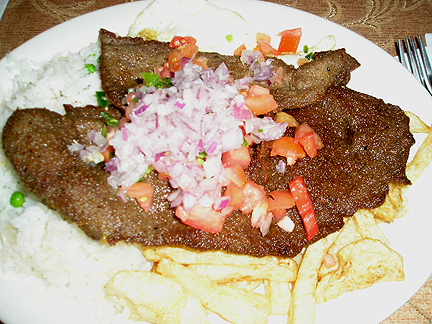
A very good mom n’ pop, gets crowded too. Most of the restaurant is in the back room. I am fond of the silpancho here, chilies and tomatoes and egg piled on thin meat, pounded, on top of a bed of rice and fried potatoes, make sure you have them bring you the spicy green sauce to spray on top, liberally. The best soups appear on varied days, not all of the time.

Related Posts:

Posted in Arlington, Bolivian, Virginia | Tagged , , , | Comments Off on Sibarita Restaurant

“Invisible Hand to Mouth”

His goal now is to provide a guide to dining well anywhere, while minimizing risk of the Cowen nightmare, a meal that is an expensive bore. His commandments fall into two categories. The first is variations on a general mantra derived from the law of supply and demand. Eat, he urges, where “the supplies are fresh, the suppliers are creative, and the demanders are informed.” An ideal restaurant would be a sushi bar near Tsukiji fish market in Tokyo, where fresh fish and discerning diners make selling bad sushi unviable as a business. The height of folly, perhaps, would be my own gastroenterologically fateful decision to visit what was then the only sushi restaurant in Villahermosa, Mexico (an unforced error, I must admit).
An Economist Gets Lunch: New Rules for Everyday Foodies

If one’s goal is to eat well, Mr. Cowen’s rules are golden. Whether they produce a pleasant meal overall is another matter. It helps if you’re Tyler Cowen, or at least share his monomaniacal view that “constructing a better eating experience” means maximizing flavor at the expense of all else. A good atmosphere is not just secondary: It’s a sign that the restaurant cares about something other than what’s on the plate. Mr. Cowen says to beware of scenic views, bevies of beautiful women, and well-stocked bars. “You want to see that the people eating there mean business,” Mr. Cowen writes. Food is a business he knows intimately, although his preference for delicious meals in windowless rooms with ugly women, pictures of the Kaaba, and active blood-feuds will not be a taste shared by all.

Invisible Hand to Mouth,” by Graeme Wood, The Wall Street Journal, April 6, 2012

Related Posts:
Posted in An Economist Gets Lunch, Beautiful Women, Books | Tagged , | 1 Comment

*Culinary Intelligence*

The author is Peter Kaminsky and the subtitle is The Art of Eating Healthy (and Really Well). I enjoyed this book, here is one bit:

If I had to reduce Culinary Intelligence to one guiding principle, it would be maximizing Flavor per Calorie (FPC): the notion that if ingredients are chosen on the basis of optimum flavor, and prepared with the goal of intensifying that flavor, then you can be satisfied while eating less.

The best tip in the book is that you get most of the value of a dessert from the first bite or two. I believe also — for most but not all meals — that 80 percent of the value of a soft drink comes in the first 10 percent of your consumption of that drink. What are some other principles of Culinary Intelligence?

Originally posted on Marginal Revolution – click to see comments and suggestions.

Related Posts:

Posted in Books | Tagged , , , , | Comments Off on *Culinary Intelligence*

Sheba Ethiopian Restaurant

Sheba Ethiopian Restaurant, 3900 A Pickett Road, Fairfax, VA, 703-425-1130, 11-10, closed Sundays. (Metro Trip Planner – opens in new window) [WaPo | Yelp]

August 2014: CLOSED

Addis Ababa, Ethiopia
Creative Commons License photo credit: neiljs

Yes, Ethiopian food comes to Fairfax. A few observations: a) the food is quite tasty, if not quite the best, good enough to make you happy about eating there, b) they will cook the kitfo even if you ask for it raw (you must really insist), c) the food is otherwise not dumbed down, and d) the place fills up, at least half with “white people.” The main problem is simply the service, which utterly collapses as the place gets full, or even half full. With better service, this would be a very valuable place. As it stands, it is still worth going sometimes, especially if you arrive early.

Related Posts:

Posted in African, Ethiopian, Fairfax, Virginia | Tagged , , , , | Comments Off on Sheba Ethiopian Restaurant

“Economist Reveals How to Find Great Food”

?If food lovers want to find memorable meals, they need to follow the money, economist Tyler Cowen says.

Cowen, author of the forthcoming An Economist Gets Lunch: New Rules for Everyday Foodies, believes eaters are frequently mislead by faulty financial analyses – or by failing to appreciate how economics relates to food.

An Economist Gets Lunch: New Rules for Everyday Foodies

Economist Reveals How to Find Great Food,” by Hanna Raskin, Seattle Weekly, March 21 2012

Related Posts:

Posted in Books | Comments Off on “Economist Reveals How to Find Great Food”

“New Rules For Mindful Foodies”

Cowen argues that while Americans will pay a pretty penny to eat well, expensive food isn’t always the best. He shares his tips on eating food that’s better for you, your wallet, and the environment.

An Economist Gets Lunch: New Rules for Everyday Foodies

Tyler Cowen Shares His New Rules For Mindful Foodies,” by Margaret Rhodes, Fast Company, March 19, 2012

Related Posts:

Posted in Books | Comments Off on “New Rules For Mindful Foodies”

The taco truck mystery

Kimchi Taco Facade
Creative Commons License photo credit: Wootang01

This one comes from Felix Salmon. In my view Felix puts forward the two correct hypotheses:

…food trucks are much more likely to be run by first-generation immigrants, for a variety of reasons. Quite aside from any hard-working immigrant stereotype, that’s good news just because the food they sell is going to be that much more authentic. (Not that food trucks need to be particularly authentic to be delicious: just ask the Korean taco people.)

And:

My favorite theory is that it basically comes down to the amount of time that elapses between the taco being made and the taco being eaten. Fillings can stay warm and delicious for a while, but the tortilla really is at its very best within seconds of coming off the stove, rather than getting soggy at the bottom of a tortilla warmer brought to you by your server. I suspect that if you could walk into the kitchen of a decent taco restaurant and get the chef to make you one then and there, it too would taste better than the same taco ordered off the menu.

I would add one factor. Taco trucks are mobile, and they often serve Latino construction workers, who are themselves mobile in terms of choosing various workplaces over the course of a year, and thus they require mobile sources of food. This encourages the taco truck, but not the stationary restaurant, to invest in better and more authentic food.

Originally posted on Marginal Revolution – click to see comments and suggestions.

Related Posts:

Posted in Food Trucks/Street Vendors | Tagged , | Comments Off on The taco truck mystery