Not my very favorite Bolivian place, but competitive with the other good ones. It is the place where you are most likely to see a huge, disgusting pile of Pique Macho with ketchup and mustard slathered on top. That’s worth something. They also have a kidney soup which no other place around seems to. If you live nearby, at the very least this is worth a visit. Like most Bolivian places around, they will simply assume that you speak Spanish.
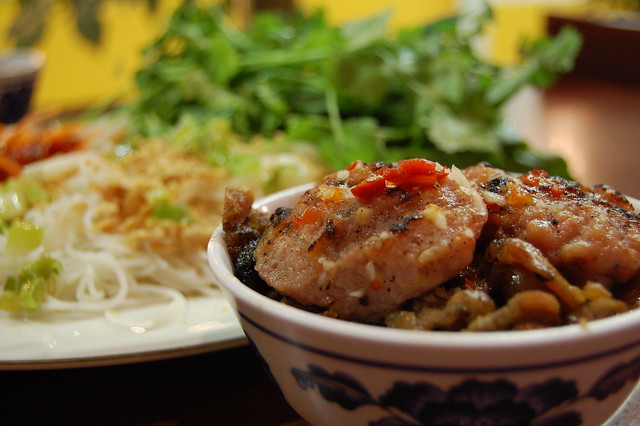
When the head cook of Viet Taste in Falls Church gets an order for a plate of Bun Cha Hanoi, he knows exactly what to do.
He has cooked the pork dish — with vermicelli noodles, greens and pickled vegetables — countless times and knows exactly how much fish sauce and fresh herbs to add.
bun cha hanoi, by stu_spivack
Outside his kitchen, the customers, most of them Vietnamese, are expecting authentic Vietnamese cuisine. German Sierra, born in Honduras, makes sure they get it.
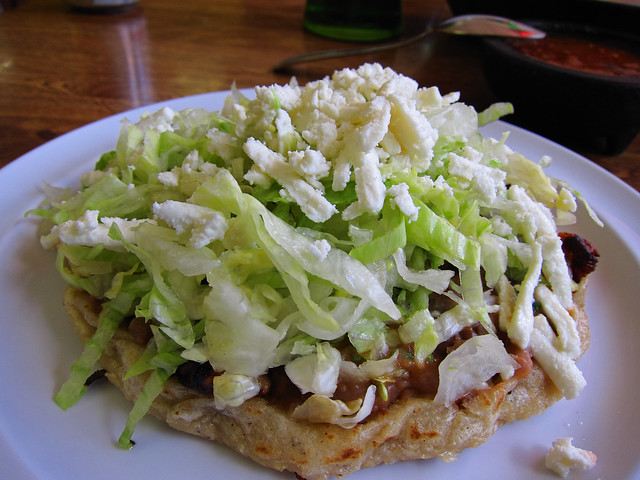
This place is really good. Mom and pop. The chef is from Jalisco and the place serves mostly tacos, snack food, tamales, and so on. The best guacamole I’ve had in this area. First-rate sopes carnitas. Above-average tacos but the sopes are better. Cheap prices. The sort of place that many of you are clamoring for.
A. Rothbard was quite a conservative eater, but he loved the Bavarian culture of the Baroque. Mises grew up in the Austro-Hungarian Empire. So I suggest that we would all sit down and have a Wiener Schnitzel together.
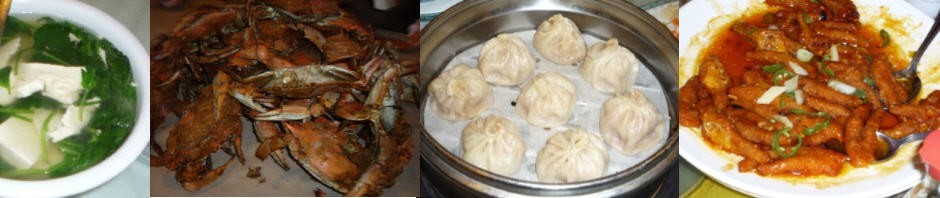
An odd mix of a totally normal “American-Chinese” restaurant, eight or so quite good Hong Kong style noodle soup dishes with dumplings, fish and chips, and steam crabs. The latter three I like, and the seafood is reasonably priced. I am never sure how good this place is, but it appeals to some of my weaknesses and so I will continue to visit. It has become quite popular, including with non-Chinese and African-Americans.
Today’s food activists think that “sustainable farming” and “eating local” are the way to solve a host of perceived problems with our modern food supply system. But after a thorough review of the evidence, Pierre Desrochers and Hiroko Shimizu have concluded that these claims are mistaken.
In The Locavore’s Dilemma they explain the history, science, and economics of food supply to reveal what locavores miss or misunderstand: the real environmental impacts of agricultural production; the drudgery of subsistence farming; and the essential role large-scale, industrial producers play in making food more available, varied, affordable, and nutritionally rich than ever before in history.
They show how eliminating agriculture subsidies and opening up international trade, not reducing food miles, is the real route to sustainability; and why eating globally, not only locally, is the way to save the planet.
I very much enjoyed reading the book, you can order a copy here. For the pointer I thank Daniel Klein.
Arabic Knowledge@Wharton: So when companies like Wal-Mart bring their logistics ability to Africa, it actually could be a good thing for the poor people of Africa?
Cowen: It’s exactly what we need more of. Yes.
Arabic Knowledge@Wharton: Yet there’s a fear Wal-Mart will put the smaller stores out of business.
Cowen: Yes, they do so sometimes, but they do so by charging lower prices. It makes it more accessible and more reliable. It’s not just the pricing at any one point and time. It’s what happens in the very worst periods. Companies like Wal-Mart are very, very good at keeping up supply and being regular.
Here is more, in interview form. Much of the discussion is about the Middle East:
Plus, it depends on which country in the Middle East you’re talking about. So Tunisia is better run than most places. Lebanon has a saner agricultural policy than most places. Yemen is a total disaster. Algeria and Egypt have not gone so well. So there’s a lot of variety within the Middle East. If you think of a model like Turkey, which isn’t technically in the Middle East, they’ve liberalized and encouraged agribusiness. Turks are much better fed than 20 years ago. When you ask a country like Iran, what should we do? It’s hard to know even where to start.
And this:
I’m not even sure Yemen is even a viable country because there’s some chance, they will literally run out of water in the next 20 years in a lot of parts of the country. At this point, I don’t know what they can do.
Among young Parisians, there is currently no greater praise for cuisine than “très Brooklyn,” a term that signifies a particularly cool combination of informality, creativity and quality.
And this:
An artisanal taco truck has come to Paris. The Cantine California started parking here in April, the latest in a recent American culinary invasion that includes chefs at top restaurants; trendy menu items like cheesecake, bagels and bloody Marys; and notions like chalking the names of farmers on the walls of restaurants.
The full story is here. And if you were wondering, and I hope you were:
Ms. Frederick waded through the thick red tape of four separate Paris bureaucracies: the business licensing commissariat; the mairie de Paris, or the local municipal office; the prefecture of police; and the authority that oversees the markets. Unlike some food trucks in the United States, the ones here are not allowed to troll for parking spots, or roam from neighborhood to neighborhood. They are assigned to certain markets and days.
Now better than Rasika proper, the home base. Get the spinach chat, the aloo tikki, the sev puri, the scallop appetizer, the lamb chop tandoori, the cod dish with two flavors, the duck curry with coconut milk, and the dark lentils for an excellent meal. The other dishes are generally good but not as good as those. Not cheap, but one of the better meals in town these days.
This piece is by me, in The Washington Post. Here is one bit:
The key is to hit these restaurants in the “sweet spot” of their cycle of rise and fall. At any point in time Washington probably has five to 10 excellent restaurants; they just don’t last very long at their highest levels of quality.
Here’s how it works. A new chef opens a place or a well-known chef comes to town and starts up a branch. Good reviews are essential to get the place off the ground, and so they pull out all stops to make the opening three months, or six months, special. And it works. In today’s world of food blogs, Twitter and texting, the word gets out quickly.
. . .
Through information technology, we have speeded up the cycle of the rise and fall of a restaurant. Once these places become popular, their obsession with quality slacks off. They become socializing scenes, the bars fill up with beautiful women (which attracts male diners uncritically), and they become established as business and power broker spots. Their audiences become automatic. The transients of Washington hear about where their friends are going, but they are less likely to know about the hidden gem patronized by the guy who has been hanging around for 23 years, and that in turn means those gems are less likely to exist in the first place.
In economic terms, think of this as a quest for the thick market externalities. Search and monitoring are most intense in the early stages of a restaurant’s life, and so that is the best time to go. There is an analogy in music: Bob Dylan and Chuck Berry do not always give the very best concerts, because they do not have to. You may or may not like up-and-coming bands, but at least they will be trying very hard.