Excellent food, sometimes called Italian but fundamentally American in my book, with some pasta courses to make it even more American. The menu seems to change, but my favorite dishes (upon sampling nine or so) were the black linguini and the cod spread on toast. Everything was good or very good, except the dessert disappointed.
The prices are reasonable for the quality and the level of noise is manageable and the décor is attractive, so pluses all around, an excellent addition to the DC repertoire.
They have a new set of dishes, right now only on weekends but perhaps they will be extended to weekdays. On a weekend evening they will have four or so dishes, during the day two or so. These are their very best dishes and they are superb. I love their Ka Nom Jeen, a Burmese-influenced noodles with curry composition. The tuna appetizer looks a bit like sawdust (really) but is first-rate and original. The Hung Lay Curry is a knockout, with Laotian and Burmese influences. Gary Leff has a good review of those dishes here. Let’s hope they keep these dishes.
Elephant Jumps was already in the elite group of ethnic restaurants, and this pushes them yet one step higher.
Run by Vietnamese from Louisiana, and they have a touching story, ask them about it if you wish. Lots of crab. Lots of Po Boys. And boiled spicy crawfish. Fried fish too. Fresh Beignet for dessert. I quite like this place. I don’t like Po Boys more generally, but if I were going to have one in NoVa, I would start here. Spicy crawfish don’t really disappoint.
This place does not rival the peaks of southwest Louisiana, but can you go here and enjoy yourself at very reasonable prices? Absolutely.
That is the current rage in the DC dining scene, namely that you can more easily order lots of “small plates” rather than a big plate with steak and spinach. Neil Irwin makes the case against that practice here, Matt Yglesias responds and defends small plates.
Neither mentions price discrimination or for that matter does much analysis of price. You will recall Glazer’s Law: “It’s either taxes or price discrimination.” And usually it is price discrimination.
Here is Alex on bundling cable channels as a form of (possibly) welfare-improving price discrimination. Read through that stuff if you don’t already know it, but the punchline is that big plates are like a “take it or leave it” cable contract, and small plates are like the a’la carte cable pricing schemes. The bundled contract gets some marginal channels to people who wouldn’t otherwise be willing to pay for them if those channels were sold on a stand-alone basis. In the TV context some of us browse reality TV, Farsi news, and women’s roller derby, even if we wouldn’t pay for those transmissions per se. In the restaurant context, the big plate gets some of us to eat more vegetables and munch on more parsley. Who would pay much for coleslaw? Output goes up under many of the most basic scenarios and consumer welfare goes up too.
In a more competitive market, as indeed the DC restaurant scene has become, bundling breaks down somewhat. We move toward a system of “small plates.” So the increasing competitiveness is good for consumers but the breakdown of bundling can be bad for them, with indeterminate welfare results, which means either Neil or Matt can be correct (but do lay out the whole story, and never ever ever reason from a plate size change!)
Those who have a relatively low marginal value for the add-on items of a meal (vegetables?) will be the ones who eat less under a regime of small plates. How their consumer surplus fares, a priori, is more complex and is not easily settled by theory alone. But, using some typical numbers, very often those who value the vegetables inelastically are worse off under a regime of small plates.
I wonder whether Neil Irwin or Matt Yglesias likes vegetables more?
It is in a dump of a roadside motel. You must of course ask for the secret Chinese menus, as the Chinese-American fare does not appear to be of interest. They have have a special Shaanxi noodles dish, get it. They have a special Xian dish which you can think of as like a Chinese hamburger, albeit with pork, Rouge Mo. Get it. They have the best Dan Dan noodles this area has seen, ever. Get it. The best cold Chengdu spicy noodles I have had. The best cumin beef of any place around. The spicy fish wasn’t bad, but not up to the other really good Chinese places around here. In any case this is a top drawer Chinese restaurant and for authenticity it is #1 around of all choices.
You will note it is hard to get here, even with a car. If you are driving east on New York Avenue, you will be constrained by a divided road, and you need to make a funny U-turn at the sign for The Washington Times building, and go under an unpromising overpass back to a service road, eventually the move will pay off, if it doesn’t feel wrong you are not doing it right.
MR commenters suggest “turn onto Bladensburg Road going north, and then hanging a right into the parking lot behind the Checkers and driving to the Days Inn through the various parking lots.” and “you will see a ‘Days Inn Entrance’ sign on Bladensburg just behind Hogs on the Hill (which is just behind Checkers).”
Not a yuppie Thai place and not quite a mom and pop, but rather imagine a Thai restaurant created for, among others, non-Thai Asians. This reminds me of the kind of Thai restaurant you might find in Seoul. Most dishes are above average, though I cannot say extraordinary.
The Mieng Kham is “A traditional Thai snack…green leaves filled w/roasted peanuts, pieces of limes. Shallot, ginger, roasted coconut ship and homemade sauce.” It is one of the best Thai dishes in this whole area and it is reason enough to visit this restaurant. Overall this place is definitely good, but if it took more chances it could be better yet.
The restaurant Spoleto told every female customer she didn’t have to pay for her meal as long as she could affirmatively answer the question, “Are you beautiful?”
It is a Brazilian fast food chain, so just stop in for a drink. By the way, they report that sales that day were up 35%.
Here is more, including an illustrative video, and for the pointer I thank Donnie Hall.
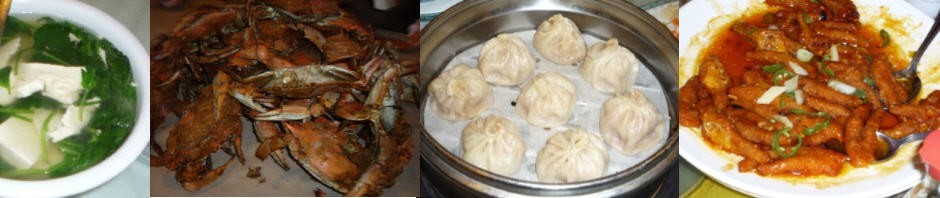
Consistently excellent Chinese food. For all of the Shanghai packaging, you can think of this as mostly Taiwanese food with Shanghai and Sichuan around the edges (a good mix!). The Xiao Long Bao are quite good and you can get them with either pork or “crab yolk,” both are worth trying. The Peas with Mustard Greens are a must and in general this place has the best and freshest greens of any Chinese in the area. Get the Taiwanese cucumbers too. First-rate noodles. I also liked the flounder fillet in chili sauce and thought the Taiwanese sausage was quite subtle. Definitely recommended.
One of the two or three best Bolivian places around and more consistent than most. Right now this is perhaps my favorite Silpancho. The chef is from Santa Cruz, which doesn’t seem to make a huge difference, but it is a slight variation on the Cochabamba emphasis in all the other places. They still have mostly Cochabamba dishes, though some of the other meats and small bready dishes are more in the Argentinean direction. Beware: it can fill up and get crowded on weekends, leading to waits, so go fairly early. It is also slightly “nicer” than most area Bolivian restaurants, yet without feeling sterile or overdone. So this one I can definitely recommend.
Which raises a delicate question: Having already eclipsed Paris in Michelin stars, could Tokyo chefs one day eclipse the French at their own cuisine?
I put the question to pastry chef Sugino, who trained in France and is one of only four Japanese members of the prestigious Relais Desserts, an association of the world’s top pastry makers who meet regularly to exchange ideas.
Choosing his words carefully, he notes that pastry shops in France are having difficulty finding young people willing to put in the time and effort required to learn the craft. He also says that even top French patisseries are now taking shortcuts — by using stabilizers in their desserts, for instance.
“They are losing the basics,” Sugino says. “It is possible that, 10 or 20 years from now, the French will have lost the art of pastry but that it will live on in Tokyo, in Japan.”